
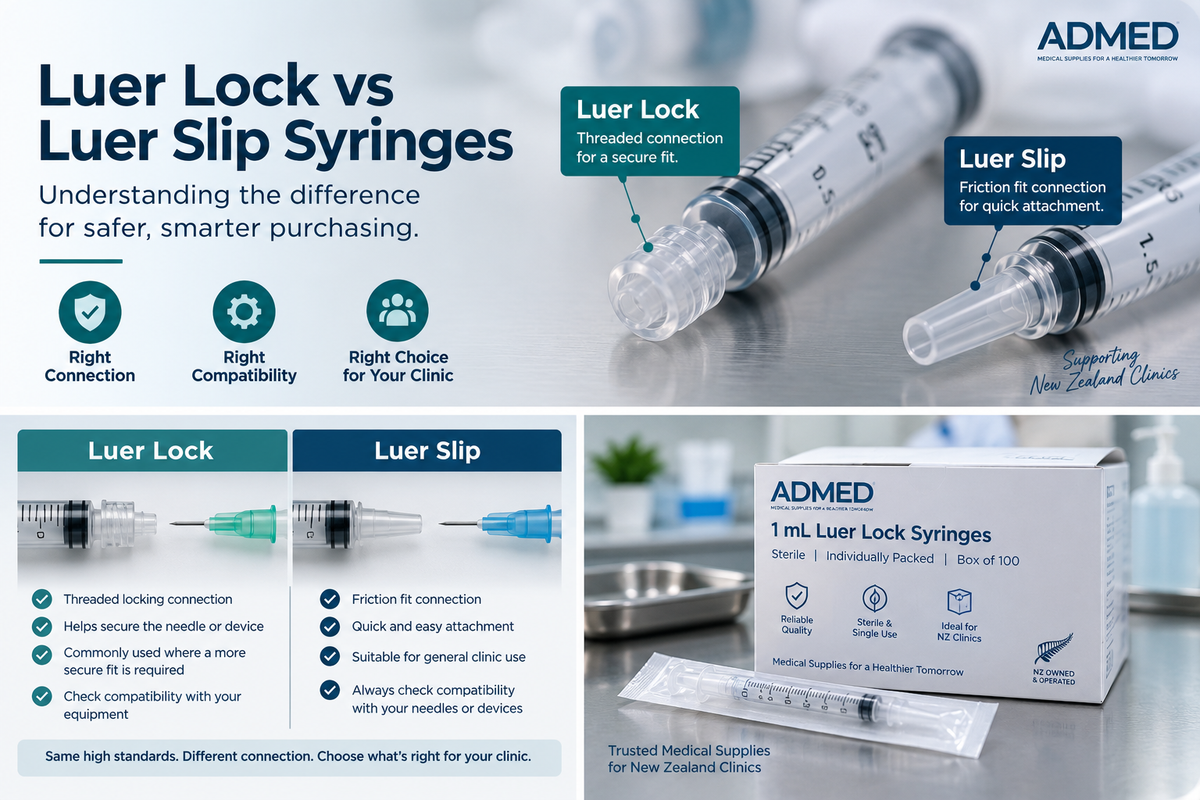
Understanding Luer Lock vs Luer Slip syringes starts with one practical difference: how the syringe connects to a compatible needle or device. A Luer Lock connection uses a threaded locking mechanism, while a Luer Slip connection relies on a friction fit. Neither name, by itself, tells you the syringe’s capacity, measurement accuracy or suitability for a particular procedure.
For clinics buying medical supplies in New Zealand, the useful question is not simply which design is “better”, but which product matches the required specifications. This guide explains the main differences and what to check when comparing medical syringes for your practice.
What Is a Luer Lock Syringe?
A Luer Lock syringe has a locking collar that engages with a compatible connector. The tapered surfaces form the connection, while the threaded mechanism helps secure the components together. This provides mechanical retention beyond the friction fit alone.
The main benefit is connection security. Luer Lock designs are used where a secure syringe-to-device connection is required, but the locking mechanism should not be treated as a guarantee against every leak or disconnection. Product selection still needs to account for the intended application and associated equipment.
When browsing Luer Lock syringes, check the complete product description rather than choosing on the connection name alone. Confirm capacity, packaging, manufacturer information and any stated compatibility requirements before adding a product to your clinic’s ordering list.

What Is a Luer Slip Syringe?
A Luer Slip syringe uses a tapered friction-fit connection without a threaded locking collar. Manufacturer guidance may describe a push-and-twist attachment, so “slip” should not be interpreted as meaning that no securing action is necessary. Always follow the instructions supplied with the specific product.
For purchasing purposes, the distinction is straightforward: Luer Slip relies on the friction fit, whereas Luer Lock adds a locking mechanism. Do not assume that a familiar appearance makes two products interchangeable. Check the connector requirements of the needle or device that will be used with the syringe.
Luer Lock vs Luer Slip: What Really Matters?
Connection type is only one part of syringe selection. Manufacturers offer both Luer Lock and Luer Slip syringes designed to meet relevant performance requirements. It would therefore be misleading to describe all Luer Slip syringes as prone to leaking, or all Luer Lock syringes as automatically more accurate.
Separate the comparison into three questions: does the connection meet the equipment requirements, does the syringe offer the required capacity and scale, and is the product intended for the planned use? Reviewing these details together is more useful than ranking syringes by tip style alone.
Also avoid assuming that a locking connection makes any syringe suitable for high-pressure equipment. Check the device manufacturer’s requirements and obtain confirmation when compatibility or operating limits are unclear.
Check Syringe Capacity and Needle Compatibility Separately
Syringe capacity and connection type describe different characteristics. Capacity is the stated volume, while Luer Lock or Luer Slip identifies the connection design. The scale markings are another specification to verify, especially when comparing products with different measurement increments.
Needle compatibility deserves its own check. Some manufacturers explicitly state that their needles work with both standard Luer Lock and Luer Slip syringes, but that does not establish compatibility for every needle, syringe or accessory on the market.
When reviewing injectable micro needles, assess the hub connection alongside gauge, length and intended use. Ask for product documentation when the listing does not provide enough information. Buying the syringe and needle from the same supplier should not replace this specification check.
Buying 1 mL Luer Lock Syringes for Your Clinic
ADMED lists 1 mL Luer Lock syringes in boxes of 100. The product page describes them as sterile and individually packed, making capacity, connection type and pack quantity clear starting points for your purchasing comparison.
Before ordering, confirm the measurement increments and package contents against your clinic’s requirements. Do not assume a needle is included unless the listing or supplier confirms it.
For repeat purchasing, record the exact product name and code in your stock system. Keep the approved specification alongside it so future orders can be checked against the same criteria, rather than relying on a photograph or a shortened product name.
Sterile Syringes and Single-Use Requirements
Choosing between connection types does not change the importance of safe injection practices. Needles and syringes used for injections must not be shared between patients, even when the needle is changed. A locking connection does not make a used syringe suitable for another patient.
When purchasing sterile syringes, include packaging condition, expiry information, storage instructions and traceability details in your checks. Ask the supplier to clarify missing information before accepting an alternative product.
Keep purchasing decisions aligned with your clinic’s infection-prevention procedures and the manufacturer’s instructions. This article is a buying guide for healthcare professionals, not a substitute for clinical training or product-specific directions.

Compare Value When Ordering Syringes in NZ
For clinics comparing syringes in NZ, assess the complete order rather than the headline box price. Divide the pack price by the number of syringes, then account for GST, delivery charges and any separately required components.
A simple purchasing record can include the supplier’s product code, connection type, capacity, graduation interval, units per sealed box, expiry date and agreed reorder quantity. Use it when requesting quotes or comparing alternatives. This keeps the comparison focused on matching products and gives the person placing the order a clear reference when your usual item is unavailable or the packaging description has recently changed.
Consider stock levels and reorder timing as well. A larger order is only useful when it matches expected demand, available storage and the product’s expiry information. Keep an agreed reorder point for routinely purchased clinic consumables.
ADMED supplies medical products nationwide from its Auckland warehouse. To discuss current availability, package details or documentation before ordering, contact ADMED.