
Choosing microneedling cartridges starts with two questions: what cartridge specification does your clinic require, and which cartridges are documented as compatible with your pen? Before comparing prices or placing a repeat order, bring those details together in a clear purchasing specification.
For clinics researching microneedling cartridges in NZ, descriptions such as “12-pin”, “round nano” and “liquid adjustable” are useful starting points. However, each describes a particular feature rather than providing a complete explanation of compatibility, intended use or packaging.
This guide explains how to interpret cartridge descriptions, compare ADMED’s listed options and organise purchasing checks. Browse ADMED’s microneedling pen and cartridge listings, then assess each product against the requirements of your particular device.
What Is a Microneedling Cartridge?
A microneedling cartridge is the replaceable treatment head used with a compatible device. In a needle-based pen system, it contains the needle arrangement that contacts the skin. Motorised microneedling devices move their needles, and some systems allow practitioners to adjust their movement or protrusion through the device’s controls.
For purchasing purposes, separate the cartridge description into individual fields: tip configuration, stated dimensions, compatible device, packaging and any additional features.
Pin count, needle length and liquid-flow adjustment are different specifications. Do not treat one as a substitute for another. A cartridge name may describe several features at once, so read the full listing rather than choosing from a photograph or shortened product title.

Understanding 12-Pin Microneedling Cartridges
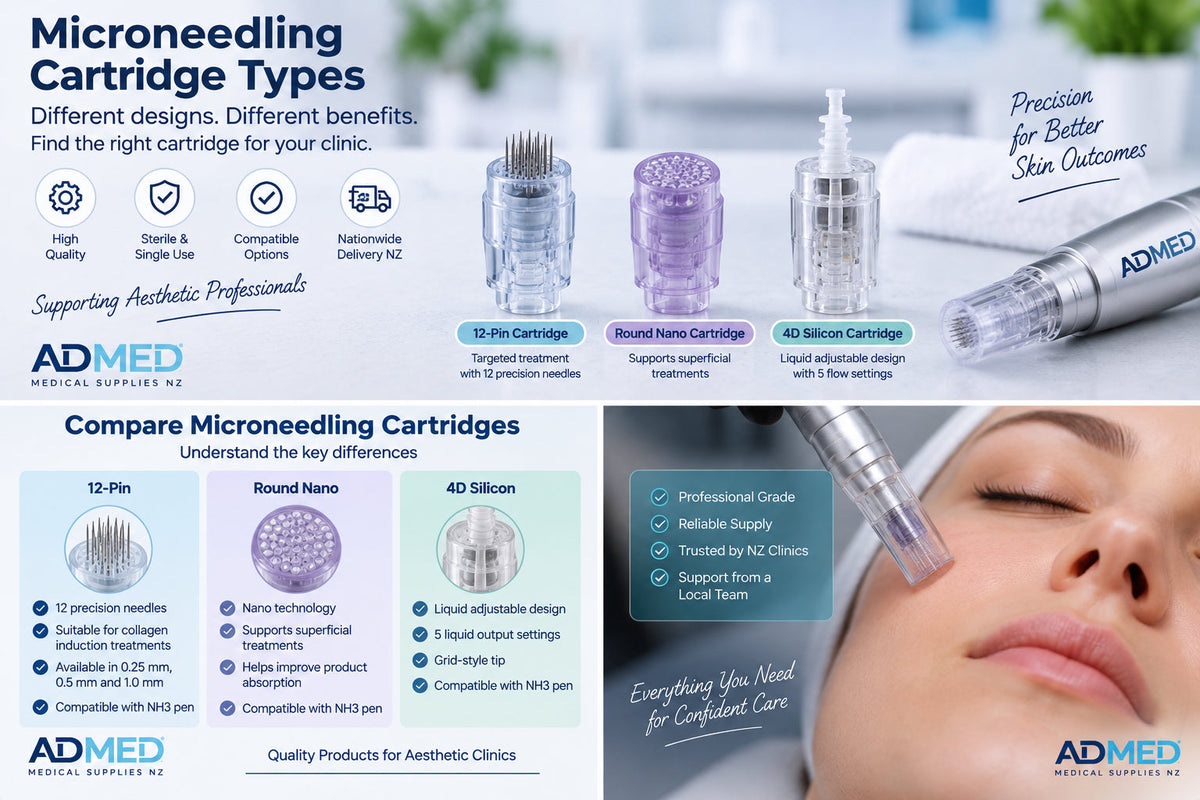
A 12-pin microneedling cartridge identifies a cartridge with a 12-pin configuration. ADMED’s 12-pin liquid-adjustable cartridge lists options labelled 0.25 mm, 0.5 mm and 1.0 mm. Its product information identifies these as NH3 pen consumables.
When preparing an order, record both the cartridge type and the selected size variant. Requesting “12-pin cartridges” alone leaves out information needed to distinguish between the available options.
Keep the catalogue dimensions separate from clinical instructions. A listed millimetre measurement identifies a product option; it is not a recommendation to use that specification on a particular area or patient.
For repeat purchasing, use a complete description such as “NH3 12-pin cartridge, selected size variant”, followed by the supplier’s product code. Confirm the exact device model and approved specification before finalising the order.
Understanding Round Nano Cartridges
ADMED also lists a Round nano liquid-adjustable cartridge. Before selecting this option, request the detailed tip specification, intended use and compatible pen information rather than relying on the word “nano” alone.
The important distinction is what the tip is designed to do. Some skin-treatment tools act only on the outermost skin layer, while others have needles that penetrate deeper. The FDA’s explanation of microneedling products distinguishes these different actions; they should not be treated as equivalent simply because products appear under similar marketing descriptions.
When comparing a nano cartridge vs a needle cartridge, ask about the actual tip construction, material and intended action. Do not assume “nano” automatically means needle-free, non-penetrating or suitable for every client.
Record the approved nano cartridge as its own stock item. Avoid substituting it for a conventional needle cartridge without a documented reason and appropriate professional review.
Understanding 4D Liquid-Adjustable Cartridges
ADMED’s 4D Silicon liquid-adjustable cartridge is described as having a grid-style tip, a built-in liquid reservoir and five liquid-output settings. The listing explicitly identifies compatibility with NH3 microneedling pens.
The key purchasing distinction is that liquid adjustment describes liquid output. Do not interpret five flow settings as five needle-depth settings. Similarly, keep the “4D Silicon” product name separate from any clinical conclusions about penetration, comfort or results.
For this cartridge, confirm the exact supported pen model, tip specification, reservoir instructions and permitted use before ordering.
Liquid Output Does Not Establish Serum Suitability
A liquid reservoir is a product feature, not proof that any skincare formula is suitable for use with the device. The US FDA states that it has not cleared microneedling devices for use with other products and has not evaluated the safety or effectiveness of those combinations. This is US regulatory guidance, not a statement of New Zealand product approval.
For your clinic’s purchasing decision, obtain documentation covering the device, cartridge and any accompanying product. Do not assume that a serum intended for ordinary topical application is appropriate for use through a cartridge.
How to Check Microneedling Cartridge Compatibility
Microneedling cartridge compatibility should be confirmed by exact device model—not appearance alone. Device manufacturers describe features beyond the attachment itself, including needle-motion mechanisms and cartridge recognition or lockout systems. These illustrate why a similar-looking connector is not complete evidence of compatibility.
Start by recording the manufacturer, model name and version shown on your pen. Then compare those details with the cartridge’s documentation. Where a listing identifies a device family, ask whether the confirmation covers your exact model.
This distinction matters within ADMED’s catalogue. The 4D cartridge description refers to NH3, while a separate pen listing is named M1O Hydra Microneedling Pen. The published information reviewed does not establish that these names identify interchangeable cartridge systems. Obtain confirmation before pairing them.
For a supplier enquiry, provide both product codes and the model information from the pen. Ask for the relevant compatibility document or manufacturer’s instructions, and retain that confirmation with your approved purchasing record.
Do not use a trial attachment on a patient as a way to establish compatibility. Resolve the documentation before the cartridge enters clinical use.
Keep Clinical Suitability Separate From Product Matching
Finding a cartridge that matches a pen does not complete the clinical selection process. Microneedling requires appropriate training, and the FDA advises practitioners not to use these devices without the necessary experience.
Keep two approvals separate: the purchasing approval for the correct component and the professional decision about whether a procedure is appropriate.
Avoid choosing a cartridge solely because it has more pins, a longer listed dimension or an additional liquid-control feature. Ask the responsible practitioner to define the required specification, then purchase against that documented requirement.
This approach keeps the ordering process precise without turning a product comparison into treatment instructions.

Sterile Packaging and Single-Use Requirements
When buying sterile microneedling cartridges, check the actual labelling and documentation. Treat “individually wrapped”, “sterile” and “single-use” as separate items to verify, rather than assuming one phrase confirms all three.
The FDA advises using a new microneedling cartridge for each patient and each treatment session, including another session with the same patient. Cleaning a used cartridge does not make reuse acceptable under that guidance.
Include packaging condition, expiry information, batch identification and storage instructions in your receiving checks. Set aside products with damaged packaging or unclear identification until the issue has been resolved.
The reusable parts of a microneedling device also require cleaning and disinfection according to the device instructions. Replacing the cartridge does not remove those responsibilities.
Keep the relevant instructions accessible to staff responsible for receiving, storing and using the equipment.
Buying Replacement Microneedling Cartridges in NZ
For clinics comparing replacement microneedling cartridges, establish an equivalent specification before comparing prices. Review the complete purchasing requirement rather than treating every cartridge with the same pin count as the same product.
Use a simple record to organise your comparison:
Purchasing detail What to record
Device identification Manufacturer, exact pen model and version
Cartridge specification Product code, tip type and selected size variant
Compatibility evidence Supporting instructions or written confirmation
Packaging and traceability Units supplied, sterile labelling, batch and expiry details
Order cost Price per cartridge, GST and delivery charges
Confirm whether the displayed price applies to one cartridge or a multipack. Calculate the unit cost consistently, then include delivery and GST when comparing complete orders.
For bulk purchasing, review expected usage, storage space and remaining shelf life before increasing the order quantity. Keep different cartridge types and variants separate in your stock records.
Set a reorder point for each approved item and identify who can authorise an alternative. When the usual product is unavailable, do not let a similar name or lower price replace the compatibility check.
A useful final check is to compare the received package against the purchase order before placing it into stock. Record any change in product code, packaging or specifications and resolve discrepancies with the supplier.
Find Microneedling Cartridges and Clinic Supplies at ADMED
ADMED is a New Zealand-based medical supplies distributor delivering nationwide from its Auckland warehouse.
When reviewing cartridge options, bring the essential details together: exact pen model, cartridge configuration, selected variant, packaging and supporting instructions. Use that information to create a repeatable purchasing process rather than relying on memory or product photographs.
For questions about specifications, compatibility documentation or current availability, contact ADMED with your pen model and the cartridge product code.